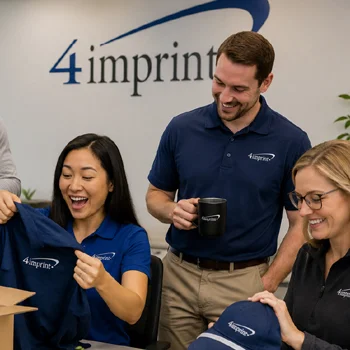
The New Workplace Welcome: Why Employee Onboarding Is Becoming A Brand Experience
Promo Pro Guide
Read Time: 8
Posted: September 10, 2026
For many businesses, onboarding once began with paperwork, an IT login and a quick introduction to the office.
The modern workplace is making that increasingly difficult for some.
A new employee might spend their first day at home, join a video call with colleagues they have never met in person, receive equipment by post and complete much of their induction online. Even when they do enter an office, hybrid working means the traditional assumption that they will spend every day in the same physical environment no longer applies.
As a result, businesses are having to rethink what ‘welcome’ in the workplace actually means.
The first impression is no longer confined to a reception desk or a handshake. It can begin weeks before someone joins, continue through their first virtual meeting and extend into the physical products and experiences that accompany them into their new role.
Onboarding is becoming more than an administrative process. It is becoming an expression of the employer brand.
The Workplace Welcome Now Starts Before Day One
The relationship between an employee and an organisation can begin long before their first morning.
An offer letter, communication from a manager, information about the team and instructions about what to expect can all influence how a new starter approaches their first day.
For businesses operating hybrid or remote models, these early interactions become even more important.
There may be no opportunity to walk someone around the office or introduce them informally to colleagues over coffee. Instead, employers have to create the moments that would once have happened naturally deliberately.
That has changed the role of onboarding. It is no longer simply about making sure someone has the right forms completed and access to the right systems. It is about reducing uncertainty, establishing connections and giving people a sense of what they are joining.
For employers competing for skilled people, that first impression can be an important opportunity to demonstrate that the experience promised during recruitment reflects the reality of working there.
Why the Physical Welcome Still Matters
Much of modern onboarding is digital. For example, documents are completed online, meetings take place via video platforms, training is delivered through learning systems, and internal communications arrive via email and workplace collaboration tools.
That makes physical touchpoints surprisingly powerful.
A welcome package delivered before the first day can provide something tangible in an otherwise digital experience. A carefully chosen notebook, reusable bottle, laptop bag or technology accessory can be useful from the outset while also giving the new employee something physical that connects them with the organisation.
The product itself is not the point. The thought behind it is.
A laptop backpack acknowledges that someone may be moving between home, office and client locations. A reusable travel mug recognises the reality of commuting. A notebook can become part of meetings and training. Technology accessories can help someone get set up for the practical demands of their new role.
These small details can communicate something that an automated onboarding email cannot. That is particularly important during a period when a new employee is absorbing an enormous amount of information.
Onboarding is Becoming Part of the Employer Brand
For years, employer branding largely focused on attracting people. Recruitment advertising, careers websites, social media and employee testimonials were designed to communicate why someone should want to work for an organisation.
The experience after accepting the job is often treated separately. That distinction is becoming less meaningful.
If a business promotes itself as innovative but provides a disjointed digital onboarding experience, there is an obvious disconnect. If it talks about sustainability but fills a welcome package with disposable merchandise, the physical experience tells a different story.
Employees experience the brand from the inside. That means onboarding should increasingly reflect the same qualities an organisation promises externally.
A business that values quality can demonstrate it through thoughtful details. For example, a company that promotes flexibility can design an onboarding process that works equally well for people joining remotely. An organisation that talks about its culture can introduce new employees to it through people, communication, and experiences rather than simply listing its values in a presentation.
Therefore, the welcome pack and the promotional merchandise included in it serve as evidence of the brand promise.
The Opportunity for SMEs
For smaller businesses, this does not necessarily require a large budget.
In fact, SMEs can have an advantage because they often have the freedom to make the experience more personal.
A welcome note from a founder or managing director can feel more meaningful than a generic corporate message. A carefully selected welcome kit can reflect an individual's role or working pattern. A team introduction can be designed around the person rather than a standard checklist.
The difference is attention.
A business does not need to give every new employee a wide range of branded products. It needs to demonstrate an understanding of the experience of joining the organisation.
That might mean providing a useful notebook and drinkware for someone joining a consultancy, a business bag for a hybrid professional or practical technology accessories for someone who will spend much of their time working remotely.
That’s because the best welcome experiences feel considered rather than extravagant.
From Employee Onboarding to Employee Experience
The significance of onboarding extends beyond the first week.
A new employee is learning how the organisation communicates, how managers behave, how colleagues interact and what the business actually values. Those experiences begin shaping their understanding of the company long before they have established their own routines.
That is why onboarding increasingly sits at the intersection of HR, internal communications and marketing.
HR may own the process, but the experience belongs to the whole organisation.
Marketing can contribute by ensuring the brand is represented consistently. Managers shape the personal experience. IT determines whether the practical setup works. Leadership establishes the tone.
Even something as simple as a new starter welcome handy-can kit can become part of that wider experience when it has been selected with purpose.
The objective is not to turn employees into walking advertisements. It is to ensure that the company's first physical expression feels consistent with the organisation they were promised during recruitment.
The New Workplace Welcome
The modern workplace has made onboarding more complicated, but it has also created an opportunity.
Businesses are no longer restricted to a single first-day experience. They can begin building relationships before someone joins and continue reinforcing them across digital and physical touchpoints.
That requires a different mindset. The question is no longer, “Have we onboarded them?”
It is: “What have we shown them about who we are?”
For businesses competing for talent, that distinction matters.
A successful onboarding process should certainly provide the information, equipment and access a new employee needs to do their job. But the best experiences go further. They make people feel prepared, considered and connected to the organisation they have chosen to join.
That is why the workplace welcome is becoming part of the brand itself.
Because before employees can represent a company to customers, they must first experience the company for themselves.
And increasingly, that experience starts before they have even walked through the door.
All marks are the property of 4imprint or their respective owners.
Office for National Statistics. “Hybrid working in Great Britain.” https://www.ons.gov.uk/employmentandlabourmarket/peopleinwork/employmentandemployeetypes.
Microsoft. “Work Trend Index.” https://www.microsoft.com/en-gb/worklab/work-trend-index.
CIPD. “Flexible and hybrid working practices in 2025.” https://www.cipd.org/uk/knowledge/reports/flexible-hybrid-working/.
CIPD. “Good Work Index.” https://www.cipd.org/uk/knowledge/reports/good-work-index/.